




Spain’s next municipal elections are due to take place in May 2027, when residents will elect the councillors responsible for running their local town halls.
Although general and regional elections are normally restricted to Spanish citizens, municipal elections are different. Certain foreign nationals who are legally resident in Spain are also entitled to vote. However, eligibility depends on nationality, residence status and registration in the electoral census.
Simply being registered on the local padrón does not automatically give someone the right to vote.
Spanish citizens
Spanish citizens aged 18 or over may vote in municipal elections provided they are registered as resident in a Spanish municipality and included in the electoral census.
Spanish citizens who are permanently resident abroad and registered in the Censo Electoral de Residentes Ausentes, commonly known as CERA, cannot vote in Spanish municipal elections. They may still vote in general, regional and European elections, depending on the circumstances.
Citizens of European Union countries
Citizens of any European Union member state may vote in Spanish municipal elections while living in Spain.
In addition to Spanish citizens, this includes nationals of Austria, Belgium, Bulgaria, Croatia, Cyprus, Czechia, Denmark, Estonia, Finland, France, Germany, Greece, Hungary, Ireland, Italy, Latvia, Lithuania, Luxembourg, Malta, the Netherlands, Poland, Portugal, Romania, Slovakia, Slovenia and Sweden.
EU citizens must be at least 18 years old on polling day, registered on the padrón in the municipality where they normally live and included in the electoral census.
They must also formally declare that they wish to vote in Spanish municipal elections. This is sometimes referred to as making a “declaration of voting intention”.
The declaration can be made through the local town hall or electronically through the INE website when the necessary identification requirements are met.
Once an EU citizen has made this declaration and has been included in the census, the registration normally remains valid for future municipal elections unless the person asks to be removed or no longer meets the necessary conditions.
British citizens can still vote
British citizens lost their automatic rights as European Union citizens following Brexit. However, Spain and the United Kingdom signed a separate reciprocal agreement allowing qualifying British residents to continue voting in Spanish municipal elections.
British residents must hold the appropriate legal residence status, be registered on their local padrón and have lived legally and continuously in Spain for at least three years before applying to join the electoral census.
Unlike EU citizens, British residents must apply for inclusion in the special electoral census for each municipal election. Being registered for the 2023 elections will not automatically mean that someone is registered for the 2027 elections.
British citizens should therefore watch carefully for the official registration period announced ahead of the 2027 municipal elections.
Other non-EU nationalities that can vote
Spain also has reciprocal municipal voting agreements with a limited number of countries outside the European Union.
Under the agreements currently in force, qualifying citizens of Bolivia, Cabo Verde, Chile, Colombia, Ecuador, Iceland, Norway, New Zealand, Paraguay, Peru, South Korea and Trinidad and Tobago may vote in Spanish municipal elections.
Together with the United Kingdom, this means there are currently 13 non-EU countries whose nationals may qualify.
For most of these nationalities, applicants must have been legally and continuously resident in Spain for at least five years before applying to join the electoral census.
Norwegian citizens are subject to a different residence requirement and must generally have lived legally and continuously in Spain for more than three years. British citizens must have completed at least three years of legal and continuous residence before applying.
All applicants must also be registered on the padrón in the municipality where they intend to vote and must submit their electoral census application during the official registration period.
Registration for nationals of reciprocal-agreement countries is valid only for the particular municipal election for which the application was made. It must therefore be renewed before each new round of local elections.
Which residents cannot vote?
Residents whose nationality is not Spanish, from another EU member state or from one of the 13 countries covered by a reciprocal agreement cannot normally vote in Spanish municipal elections.
This means that, under the current rules, nationals of countries such as the United States, Canada, Australia, Morocco, Ukraine, Argentina, Brazil and Venezuela do not qualify solely because they are legally resident, own a property, pay Spanish taxes or are registered on the padrón.
They may only vote if they also hold Spanish nationality or another nationality that qualifies under European Union rules or a reciprocal agreement.
Eligibility is determined by nationality rather than birthplace or the length of time someone has lived in Spain.
The padrón and electoral census are not the same
One of the most common misunderstandings is the belief that registering on the padrón automatically registers a foreign resident to vote.
The padrón is the municipal register of people who normally live in the town. The electoral census is the separate official register of people entitled to vote.
Registration on the padrón is an essential first step, but qualifying foreign residents must also complete the appropriate electoral census procedure.
EU citizens must formally declare their intention to vote. British citizens and nationals of the other reciprocal-agreement countries must apply during the specific registration period established for each election.
Do not leave registration until the election is called
The exact application period for qualifying non-EU residents is established separately for each municipal election. These registration windows can be relatively short and may close several months before polling day.
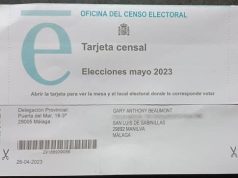
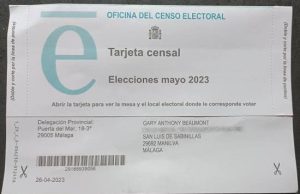
Residents should not assume that receiving a polling card, having voted previously or being included on the padrón means that they are correctly registered.
EU residents can declare their intention to vote at any time, although the process must be completed early enough for them to appear in the census used for the election.
Anyone who hopes to vote in 2027 should check their position with their town hall or the Oficina del Censo Electoral well in advance.
Municipal elections decide who controls the services that have the most immediate effect on daily life, including local roads, planning, parks, beaches, waste collection, policing, cultural activities and municipal investment.
For thousands of international residents, registering to vote is an important opportunity to have a direct say in the future of the community in which they live.