





Spain holds its municipal elections every four years, on the fourth Sunday in May. The next local elections are due to take place on Sunday 23 May 2027.
Municipal elections in Spain use a system of proportional representation. Unlike the traditional system used in UK local elections, where voters usually select an individual candidate, voters in Spain choose a political party or electoral group from a list.
Each party presents an ordered list of candidates. The number of council seats available depends on the municipality’s official population. Casares currently elects 13 councillors, meaning that seven seats are required for an absolute majority.
Council seats are distributed broadly according to the proportion of votes received by each party. However, the calculation is not simply a matter of dividing the total number of votes by the number of seats. Parties must first receive at least 5% of the valid votes cast to qualify for representation, after which the seats are allocated using a calculation known as the D’Hondt method.
The candidates take their seats in the order in which they appear on their party’s list. For example, if a party wins five seats, the first five candidates on its list become councillors.
If one party wins seven or more of Casares’s 13 seats, it has an absolute majority and can govern without the support of another party, which has been the case in the previous two elections.
If there is no overall majority, parties may negotiate a coalition or governing agreement. The mayor is elected by the newly appointed councillors. Any councillor who headed their party’s electoral list may stand for mayor and must receive the support of an absolute majority of the council to be elected. If no candidate obtains that majority, the leader of the party that received the greatest number of public votes is proclaimed mayor.
Voting on election day
To vote, you must be registered on the electoral census (see registering to vote) and attend the polling station allocated to your address.
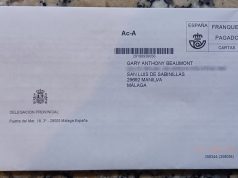
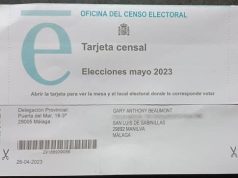
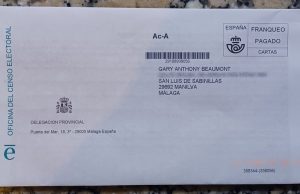
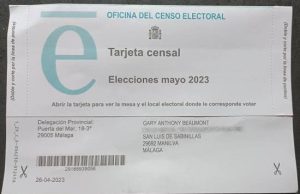
Before the election, you should receive a census card confirming your polling station and voting table. However, you do not need to take this card with you and may still vote if it has not arrived, provided your name appears on the electoral register.
Polling stations are allocated according to where you live within the municipality. We will publish a general guide to Casares’s polling stations nearer the election.
Political parties often distribute their ballot papers and voting envelopes before election day. You may prepare your vote in advance, but official ballot papers and envelopes will also be available inside the polling station.
At the polling station, you can enter a private voting booth, choose the ballot paper for the party you wish to support and place it inside the official envelope.
The ballot paper contains the party’s complete list of candidates. You cannot select, remove or rearrange individual candidates. To avoid your vote being declared invalid, do not write on, circle, underline or otherwise alter the ballot paper.
You must take an original official identity document bearing your photograph. For foreign residents, this will normally be a TIE residence card or passport, as appropriate. Your identity document is essential, although the census card itself is not required.
Proceed to the electoral table shown on your census information. A member of the polling station staff will check your identity and confirm that your name appears on the list of registered voters.
Once this has been confirmed, you will be invited to place your envelope into the ballot box. Your name will be recorded as having voted, and the representatives of the political parties present may also mark you off their copies of the electoral register.
Your choice remains completely secret. The only information recorded is whether or not you have voted.
You may then leave the polling station knowing that you have exercised your democratic right and played your part in deciding who will represent and govern the municipality for the following four years.