



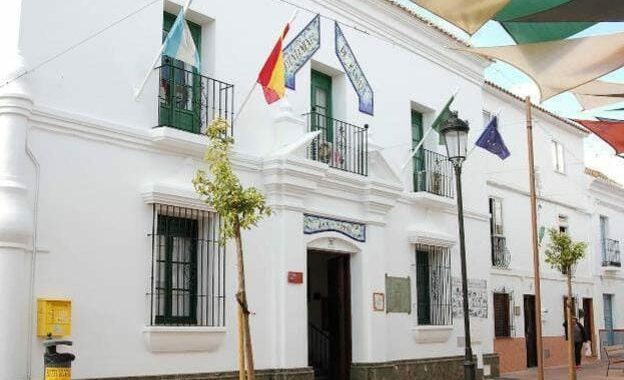
Few municipalities of Manilva’s size have experienced such a turbulent political history. Since the beginning of the century, the mayoralty has repeatedly changed hands through coalition agreements, motions of no confidence, party expulsions and the creation of new local political groups.
The result has been a political landscape in which personal alliances have often proved more decisive than traditional divisions between left and right. Alongside this instability, successive administrations have faced investigations and court proceedings relating principally to planning decisions, municipal employment and public contracts.
The GIL era and the first upheaval
The political instability of the early 2000s had its roots in the rise of the Grupo Independiente Liberal, better known as GIL, which had expanded from neighbouring Marbella into several Costa del Sol municipalities.
Following the 1999 elections, Izquierda Unida councillor Antonia Muñoz became mayor through an agreement designed to keep GIL out of power. Her first period in office lasted only about a year.
In 2000, GIL councillor Pedro Tirado helped organise a motion of no confidence that removed Muñoz and installed Socialist councillor Emilio López Berenguer as mayor. López Berenguer and the other PSOE councillors who supported the agreement were expelled from the Socialist Party for defying its instructions.
The episode established a pattern that would recur throughout Manilva’s recent history: councillors breaking with the parties under whose names they had been elected and then forming new alliances capable of changing the government.
Pedro Tirado subsequently left GIL and created the Partido Democrático de Manilva, or PDEM, in 2002. He stood under the new party’s banner in the 2003 municipal elections and became mayor with the support of Antonia Muñoz and Izquierda Unida.
Emilio López Berenguer also established a local political organisation, the Agrupación Socialista de Manilva, or ASM, after his expulsion from the PSOE. Both PDEM and ASM would play important roles in later coalition negotiations.
Pedro Tirado, La Parrada and another change of mayor
Tirado’s administration became embroiled in the investigation surrounding the La Parrada development. He was arrested in October 2005 and resigned as mayor while in custody.
Police discovered more than €760,000 concealed at his home. Tirado was prosecuted over allegations that the money was connected to planning decisions affecting La Parrada, although the courts did not ultimately establish that it had been paid in exchange for the development’s rezoning.
He was nevertheless convicted of improper passive bribery because the court concluded that the money had been received because of his public position. The Supreme Court later confirmed a fine of €12,000. The conviction therefore related to the acceptance of money by a public official, but not to a proven sale of the La Parrada planning decision.
Following Tirado’s resignation in November 2005, PSOE councillor Salvador Zotano was elected mayor with support from PDEM councillors and a non-attached councillor. The PSOE had instructed its representatives to support Antonia Muñoz instead, and Zotano was expelled for ignoring that decision.
In another example of Manilva’s fluid party politics, Zotano was later readmitted to the PSOE and returned as its mayoral candidate in the 2007 elections.
Antonia Muñoz returns to power
The 2007 election produced an exceptionally divided council. Izquierda Unida won five seats, while the PP, ASM and PSOE each secured four.
Antonia Muñoz returned as mayor through an agreement between Izquierda Unida and ASM. The pact later collapsed after two ASM representatives left the group and became non-attached councillors. Muñoz subsequently reached an agreement with the PSOE, allowing her administration to continue with a different coalition partner.
Izquierda Unida strengthened its position in 2011. Following a correction to the original count, the party was awarded eight of the council’s 17 seats, leaving it just one short of an overall majority. Muñoz again reached an agreement with ASM, whose two councillors gave the government a comfortable majority.
Her administration was popular with a significant section of the electorate, but it became increasingly overshadowed by investigations into municipal employment practices.
The municipal employment case and the break with Izquierda Unida
The investigation that became widely known as the Caso Manilva examined the large-scale recruitment of council employees and workers through municipally controlled companies.
Investigators looked at the employment of political candidates, relatives of councillors and other individuals without the usual competitive procedures. The case eventually covered hundreds of appointments made between 2007 and 2013.
As the investigation developed, Izquierda Unida’s regional leadership demanded that Antonia Muñoz relinquish the mayoralty. In 2013, Muñoz and six councillors from her municipal group broke with IU and moved into the council’s non-attached group. Izquierda Unida was consequently left without its original municipal representation despite having won eight seats in 2011.
Muñoz remained mayor for more than a year after the split but finally resigned in October 2014. Emilio López Berenguer briefly assumed the mayoral responsibilities before Diego Urieta was elected as her successor.
The former IU councillors then created a new independent local party, Compromiso Manilva. Led initially by Urieta, it allowed much of the former municipal organisation and support base around Muñoz’s administration to continue under a new name.
Years later, in 2022, the Málaga Provincial Court convicted Muñoz of continuous administrative prevarication over 749 municipal contracts made without the legally required recruitment procedures. In 2025, the Supreme Court upheld the conviction but reduced her period of disqualification from public office to six years and four months.
The ruling established criminal responsibility for the unlawful system of recruitment. It did not mean that every person employed under the system had committed an offence.
The 2015 election and Compromiso’s emergence
The 2015 election confirmed Compromiso Manilva as a major local force. The PSOE and Compromiso each won five seats, Izquierda Unida obtained four, the PP two and ASM one.
Despite Compromiso’s strong result, PSOE candidate Diego José Jiménez became mayor through an agreement supported by Izquierda Unida and ASM. Compromiso remained outside the government.
The coalition soon deteriorated. In October 2016, Jiménez dismissed the IU councillors from the governing administration, leaving the PSOE operating as a minority.
One month later, Mario Jiménez of Compromiso replaced him as mayor through a motion of no confidence. The motion brought together Compromiso and Izquierda Unida and also received support from the PP and ASM. Twelve of the council’s 17 members backed the change.
It was a striking coalition of parties with very different political backgrounds, but it demonstrated once again that control of Manilva Town Hall depended more on local relationships than national party ideology.
The 2019 Compromiso–PSOE agreement
Izquierda Unida emerged as the largest party in the 2019 election with six councillors. Compromiso and the PSOE each won five seats, while the PP retained one.
Although IU had topped the poll, Compromiso and the PSOE reached an agreement giving them ten seats between them. Mario Jiménez therefore remained mayor, with the Socialists joining the municipal government.
The arrangement was particularly notable because Compromiso had first gained the mayoralty in 2016 by removing a PSOE mayor. Nevertheless, their 2019 agreement lasted through the remainder of the term and illustrated the continuing importance of pragmatic local alliances.
The dramatic aftermath of the 2023 election
The 2023 result produced another council without a majority. Compromiso was again the largest party, winning five seats. The PP and Con Andalucía–Izquierda Unida obtained four each, the PSOE won three and Vox entered the council with one.
Compromiso and the PSOE together controlled only eight seats, one short of the nine required for a majority. PP candidate José Manuel Fernández was instead elected mayor with the support of the four councillors elected for Con Andalucía–IU and the single Vox representative.
The agreement caused an immediate rupture within Izquierda Unida. The four councillors who had supported the PP candidate — Juan Carlos Morejón, Agustín Vargas, Rogelio Pascual and Gema Zotano — were expelled by the provincial IU organisation for helping to elect a PP mayor with Vox support.
Despite their removal from IU, the councillors continued to operate municipally under the Con Andalucía designation and entered a governing arrangement with the PP. Vox supported the investiture but did not join the municipal administration.
The status of the four former IU councillors became a continuing source of dispute. Compromiso argued that allowing them to operate as a recognised group conflicted with the national anti-defection agreement, while the councillors maintained their municipal organisation and continued to hold government responsibilities.
Compromiso joins the PP — and then removes it
A further unexpected realignment took place in January 2025 when Compromiso’s five councillors joined the PP administration. The agreement gave Mayor José Manuel Fernández a nine-seat majority and significantly reduced the influence and responsibilities of the four councillors elected under the Con Andalucía–IU ticket.
The partnership between the PP and Compromiso lasted only a few months.
In April 2025, Compromiso reversed course and reached an agreement with the same four Con Andalucía councillors whose support for the PP had caused such controversy in 2023. Together, their nine representatives submitted a motion of no confidence against Fernández.
The motion was approved on 28 April 2025, returning Mario Jiménez to the mayoralty. The nine councillors from Compromiso and Con Andalucía formed a new government, while the PP, PSOE and Vox moved into opposition.
As of June 2026, the administration remains composed of five Compromiso councillors and the four councillors elected in 2023 on the Con Andalucía–IU ticket. Mario Jiménez is mayor, with Juan Carlos Morejón serving as first deputy mayor and holding several major responsibilities, including urban planning and finance.
The present coalition is politically striking. Compromiso originated in the 2013 breakaway from Izquierda Unida, while several members of the current Con Andalucía group were later expelled by IU. Former rivals have therefore become coalition partners, just as Compromiso and the PP had briefly done earlier in 2025.
Other legal proceedings
The municipal employment case is the most significant final conviction involving the Muñoz administration, but it has not been the only legal issue affecting Manilva politics.
In the case commonly known as Manilva III or the El Hacho case, Antonia Muñoz, Mario Jiménez and several former councillors and officials were prosecuted over the use of municipal funds connected with the El Hacho urban development entity.
In May 2025, the Provincial Court acquitted all the defendants. The judges identified administrative irregularities but concluded that criminal intent, personal enrichment and financial loss to the council had not been proved. This was therefore an acquittal, not a conviction.
A separate proceeding generally referred to as Manilva II concerned alleged irregularities in contracts awarded to businesses linked to people close to members of the former administration. Mario Jiménez, Antonia Muñoz and others were named in the proceedings. The latest publicly available reporting located for this article described the matter as awaiting trial or resolution. No final published judgment has been identified as of June 2026, and the allegations must therefore not be treated as established facts.
Muñoz was also detained in 2020 as part of a separate investigation into alleged money laundering through property investments. Again, an arrest or investigation is not the same as a conviction, and no final published court outcome for that matter has been identified in preparing this article.
Following his removal in 2025, the PP administration submitted documentation to the courts alleging irregularities involving Mario Jiménez, Compromiso and other councillors. These remain political and legal allegations unless and until a court determines otherwise.
A political culture shaped by personalities and local parties
The defining feature of Manilva politics since 2000 has not been a consistent contest between left and right. It has been the movement of councillors and political blocs between alliances.
Councillors elected for the PSOE have been expelled and later readmitted. Former GIL representatives created PDEM. An expelled Socialist established ASM. Most of an IU council group left the party and subsequently formed Compromiso. Four later IU councillors were expelled after helping the PP take the mayoralty, only to join forces with Compromiso two years later to remove the same PP mayor.
During this period, Manilva has been governed by combinations involving IU and ASM, IU and PSOE, PSOE with IU and ASM, Compromiso with IU, Compromiso with PSOE, the PP with former IU councillors, the PP with Compromiso, and finally Compromiso with the Con Andalucía group.
This history does not mean that ideology is irrelevant, but it shows that personal relationships, local rivalries, control of the administration and the arithmetic of a 17-member council have repeatedly outweighed national party loyalties.
With municipal elections due again in 2027, voters will not only be judging the current government’s performance. They will also be considering a political system shaped by more than 25 years of breakaways, reconciliations, court cases and unexpected alliances.